Koreya uchun layfxaklar
Koreyada qon donori bo'lish qanday? Chet elliklar ham o'z qonini topshira oladimi?
- stenkacommunity Mashhur
-
 1,996
1,996
 0
0


My personal experience of donating blood in Korea: what foreigners need to know, precautions, and tips
I donated blood at a center near Pyeongtaek subway station, and the center looked like this from the outside:

I was accepted without a prior online reservation, as there weren't many people at the center. However, if you have the opportunity, it's better to book a time online in advance – you can also fill out the health questionnaire (헌혈기록카드) there right away.
There are special terminals installed in the centers where you can fill out the questionnaire on-site. It is very important to answer honestly, for your own safety and the safety of others.
your documents and questionnaire (for accurate donor history tracking and blood analysis);
your donation history through the Blood Information Management System (혈액정보관리시스템, BIMS);
body weight, blood pressure, pulse, and body temperature.

If the medical staff deems you fit for donation, you will be directed to the procedure.
Since it was my first time donating blood, the nurse attached a "first-time donor" sticker to me so that other staff members would pay more attention.
Before donating blood, be sure to drink 2 glasses of water. Follow the staff's instructions. If you feel any discomfort, inform them immediately.
The procedure took only 10–15 minutes.
While donating blood is a selfless and noble act, the Red Cross gives souvenirs as a token of gratitude.

You could choose:
one gift from section A + one from section B,
or two gifts from section B.
I chose a movie ticket and a 5,000 won coupon for stores. I also received a restorative drink, cookies, and a blood donor badge.
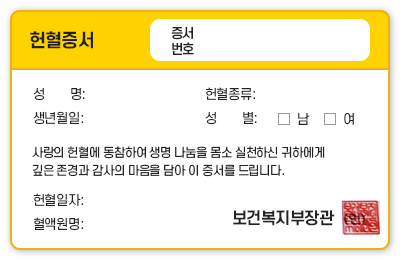
Now, I will tell you about the main conditions for foreigners to donate blood without problems:
1. To donate blood, you need to know Korean, or contact the blood center volunteers or external translators (no family members or colleagues).
2. You must have lived in Korea for a full year (time spent abroad does not count). However, if you are exempt from registering as a foreigner (e.g., holders of A-1, A-2, and A-3 visas), you can donate blood after residing in Korea for one month.
3. If you have been abroad for a total of more than 90 days in the past year, you will have to wait another year from the date of your return.
4. Additionally, if you have traveled abroad within the last month, you can donate blood four weeks after your return.
5. To participate in blood donation, you must have a valid identification: Residence Card, certificate of residence in Korea, Korean driver's license, permanent resident card, identification issued by the US Armed Forces (USFK), passport – only if you are exempt from obtaining a foreign resident card.
If you don't know Korean well, you can contact the center's volunteers by email at donateblood@redcross.or.kr
Tips after donating blood:
After donating blood, sit at a table, place your feet on the floor, rest your elbows on the table, and lean forward slightly. This position helps prevent you from falling if you feel dizzy or weak.

Drink more water than usual (3–4 glasses). This helps replenish the fluid volume lost during blood donation.
Do not consume alcohol on the day of donation and do not smoke for 1 hour after donation. Smoking within an hour can cause dizziness or nausea.
On the day of donation, avoid: hiking, extreme training, and riding amusement park attractions.
Do not lift heavy objects or engage in strenuous physical activity, as this can cause pain or bruising.
You can take a shower, but do not visit a sauna, bathhouse, or steam room on this day.
If the injection site starts bleeding, raise your arm above chest level and press firmly with your thumb until the bleeding stops.
If you operate heavy machinery or work at heights, take a break of at least 12 hours after donating blood. For airplane pilots, this is at least 24 hours.
If you feel dizzy or nauseous after leaving the blood donation center (delayed vasovagal reaction): immediately sit on the floor and lower your head between your knees, or lie down on the floor and elevate your legs until you feel better.
If these symptoms occur while driving, stop immediately and do not continue driving until you feel better.

- Oldingi yozuvMening chet ellik qo'shnim 550 000 won olganda, nega men 0 won olaman? 2025 Tirikchilikni tiklash yordami!2025.07.14
- Keyingi yozuvMehnatlaringizning mukofotlanish vaqti keldi! 🥳 Koreyaning "Ishlab topilgan daromad soliq krediti va bolalar uchun soliq krediti"ni osonda bilib oling.2025.07.13
Izohlar roʻyxati
Hech qanday izoh topilmadi.